
Uruguay: A Reliable and Sustainable Partner in International Trade
The Agreement promotes cooperation, economic growth, employment and investment, includes a dedicated Trade and Sustainable Development chapter, reaffirming multilateral labour commitments and the climate commitments established under the Paris Agreement.
Sustainable Production
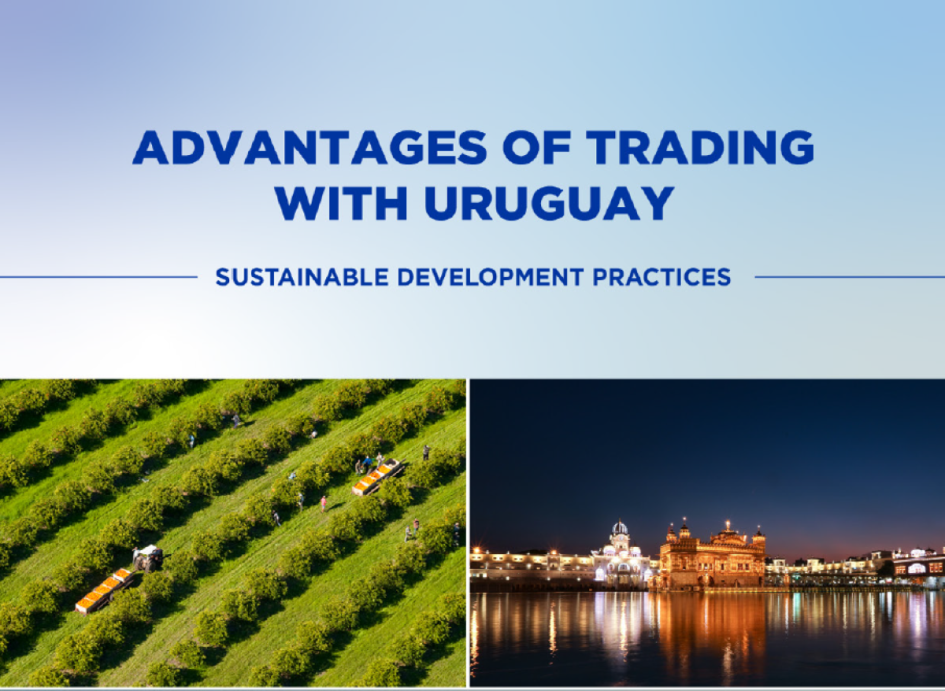
Uruguay supplies the world with traceable, safe and environmentally responsible products, combining economic growth with social inclusion and environmental protection.
Sustainable, Low-Carbon Agriculture:
Uruguay addresses climate change as a cross-cutting priority in its public policies, combining productivity, innovation and the sustainable management of natural resources.
Traceable Livestock:
100% of Uruguay's cattle herd is individually traceable through a comprehensive identification system supported by geographic information systems (GIS). This enables, among other things, the issuance of official certificates confirming that Uruguayan beef originates from farms free from deforestation. In May 2025, the European Union classified Uruguay as a low-risk country for deforestation under the European Union Deforestation Regulation (EUDR).
Forestry Sector:
Uruguay's forestry sector is characterised by the conservation and expansion of native forests since 1987, as well as the development of a bioeconomy that uses industrial by-products to generate biomass energy and promote circular-economy models.
Wine Industry:
100% of Uruguay's vineyards are officially registered and georeferenced. The National Institute of Viticulture (INAVI) promotes the Uruguay Sustainable Winegrowing programme, which certifies responsible wine production by balancing profitability, social equity and environmental protection.
Dairy Sector:
Uruguay's dairy production is based primarily on natural pastures and is supported by both public and private certification schemes.
Rice:
Uruguay is a highly specialised producer and exporter of premium-quality rice, exporting approximately 95% of its production to international markets.
Energy:
Approximately 94% of Uruguay's electricity generation comes from renewable energy sources, making the country a regional leader in the energy transition.
Sustainable Finance
Uruguay is a pioneer in the issuance of Sustainability-Linked Sovereign Bonds (SSLBs), whose financial conditions are linked to the achievement of the country's Nationally Determined Contributions (NDCs) under the Paris Agreement.
Trade Based on Values and Trust
Uruguay promotes a sustainable development model that combines open trade, social responsibility and environmental commitment. As a member of MERCOSUR and a reliable partner of the European Union, Uruguay supports sustainable value chains that foster employment, investment and shared prosperity