

23 – Citizen Digital Platform of the Public Housing System
Brief description of the commitment: Design and implementation of a Citizen Digital Platform for the Public Housing System that will centralize up-to-date information on all existing state housing programs. It will be designed so that individuals can enter their basic profile and receive guidance on the options for which they may qualify, with direct links to the current application channels.
The platform will include standardized open data, call alerts with eligibility and accessibility criteria; and will feed public indicators of coverage, demand and response times.
Organization leading the commitment: Ministry of Housing and Territorial Planning (MVOT).
Responsible for the commitment: Christian Di Candia, Undersecretary MVOT, contact: subsecretario@mvot.gub.uy ; Paola Florio, National Director of Territorial Planning, contact: pflorio@mvot.gub.uy .
Technical Managers: Paula Mosca, Advisor - pmosca@mvot.gub.uy ; Rosario Casanova, Advisor - rcasanova@mvot.gub.uy ; Anahí Bermúdez, Advisor - abermudez@mvot.gub.uy ; María Noel Lanzaro, Advisor - mlanzaro@mvot.gub.uy ; Álvaro Guerrero, Advisor - aguerrero@mvot.gub.uy ; Alberto Hughes, Manager of Electronic Government, Process and Improvement MVOT - ahughes@mvot.gub.uy .
Stakeholders:
- Government: Public Housing System (SPV) including the MVOT as the main actor and coordinator, and other state agencies of the SPV such as the National Housing Agency (ANV) as the implementing arm; the Mortgage Bank of Uruguay (BHU) as the state mortgage financial institution; the Movement for the Eradication of Unhealthy Housing (MEVIR) as a public institution of private law focused on rural housing; as well as other agencies that work in agreement with the MVOT such as the Social Security Bank (BPS) as a provider of housing solutions for retirees, the Ministry of Social Development (MIDES) as it refers specific housing emergency situations through its territorial teams and the framework of specific agreements with the MVOT, or Departmental Governments (GGDD) as they operate as the implementing arm in the territory in some programs.
- Civil Society: Federations of Housing Cooperatives; Associations and Chambers associated with the construction and real estate development industry; social organizations linked to the problem, vulnerable groups that may require housing solutions or that can channel these to the population with which they work: Not all is lost (NITEP), Dianova Foundation, Techo, El Abrojo, Gurises Unidos, among others; unorganized population that requires housing solutions.
- Other actors: Academia, Parliament, political system, media, international organizations, among others.
Implementation period: September 2025 – June 2029.
Problem definition
What problem does the commitment intend to address?
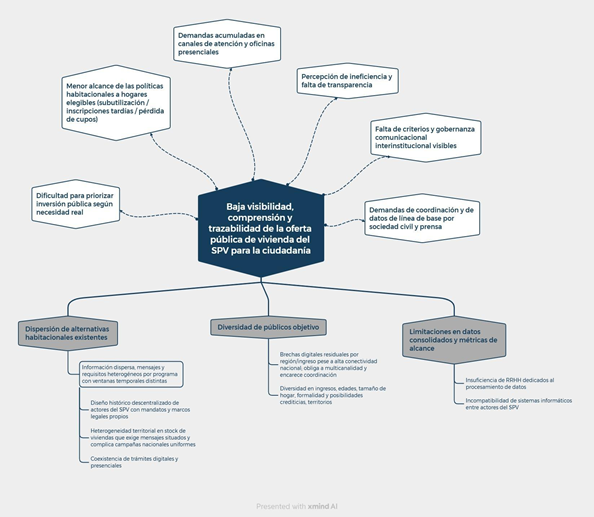
Citizens face barriers in terms of access to information and operational access to learn about, compare and apply for the public housing programs.
The existing programs and alternatives are varied, and together they provide solutions for the vast majority of the population. These include purchasing homes in private projects promoted by the State, built by the Ministry of Housing, Territorial Planning and Land (MVOT), and the existing market, either through MVOT funds or mortgage loans with and without subsidies; rent-to-own options; rental guarantees and subsidies; transitional housing solutions; relocation housing; and improvements to existing homes with and without repayment; among others. Each agency within the Housing System (SPV) has its own digital platform, at different stages of development, from which it disseminates information about the programs and tools it implements, along with the corresponding requirements and procedures, as well as forms and schedules.
What are the causes of the problem?
Difficulties in accessing information affect this entire spectrum, albeit with varying degrees of impact. For example, some programs supplement the outreach efforts of federations or developers. Meanwhile, in comprehensive, targeted interventions, such as those in informal settlements, access is primarily facilitated by the on-the-ground presence of technical teams. Therefore, the households most likely to be affected are those with middle and lower-middle incomes, or those with low incomes living in precarious, dispersed conditions.
The structural root comes from the historical evolution of the Uruguayan housing system, built, as already mentioned, by varied institutional layers and responding to different types of legal status and levels of government with variable inter-institutional coordination.
This informational and institutional fragmentation, the absence of a single, clear and up-to-date point, the limited deadlines for calls, the documentary complexity and the territorial and digital gaps leave out -or delay- the possibility of many households to access formal solutions or "dignify" their own housing, even when there are public instruments that seek to reduce barriers to entry.
In summary, the low visibility, understanding, and traceability of the public housing solutions offered by the SPV to the population reduces timely access, permanence, and the efficiency/effectiveness of housing policies.
Description of the commitment
What solution does it propose?
A public, interoperable, and user-oriented digital platform will be implemented, capable of profiling potential beneficiaries and providing eligible options within existing state housing plans and programs. This platform will integrate simulators with intelligent filters, according to location, socioeconomic status, ability to pay or savings, and ownership preference, among other criteria, in order to reduce information asymmetries and facilitate referrals to the appropriate channels.
The citizen platform will aim at addressing the problems of access and information asymmetry regarding existing alternatives and those that will continue to be generated in the present and in future five-year plans; it lowers search costs and improves guidance and streamlines procedures.
What results do we want to achieve by implementing this commitment?
The achievements in connection to the project are:
The creation of an entry point that can be self-managed by potential users, or carried out in person at existing local offices or in coordination with other organizations and associations operating in the territory
The creation of a basic standardized profile of users (location, composition, income range, tenure preference)
The creation of unique fact sheets for each program (target audience, requirements, deadlines, application channels)
The interrelation of the two previous items, generating recommendations, referrals to application sites, automatic call alert, all with live and updated content
The provision of open and easy-to-view information about existing programs and their execution.
Throughout the implementation of the commitment, the incorporation into the platform housing solutions from other actors outside of the MVOT: the rest of the SPV, other state actors, private alternatives with financing or public participation of any kind.
Commitment analysis
How will the commitment promote transparency?
The digital citizen platform will improve transparency regarding the management of the SPV (Public Health Service), and therefore, people will have clear and unified access to information about the programs and services. This also implies democratic access to existing alternatives, facilitating public access to information for decision-making.
How will the commitment help foster accountability?
Making the offer explicit represents a tool for the population regarding accountability, as well as in connection to inputs for monitoring and assessment of the programs, thus generating public indicators on searches carried out, number of applications and services used by the beneficiaries.
How will the commitment improve citizen participation in defining, implementing, and monitoring solutions?
These generated indicators provide input to identify unmet demands and reveal which programs are most frequently consulted, which are not reaching their target audience, and which ones require adjustments. Ultimately, they inform the design of future policies based on data generated from citizen participation. In this way, interested parties will not only be informed, but will also be contributing to the improvement of programs and the way the SPV (Public Housing Service) communicates and offers its housing solutions.
Milestone | Milestone description | Expected results | Completion date | Leading Institution |
|---|---|---|---|---|
1 | Formation of the SPV inter-institutional governance team. | Formal coordination instance with designated representatives from MVOT, ANV, MEVIR, BHU and BPS for decision-making, monitoring and traceability of the project. | September 2025 | Ministry of Housing and Territorial Planning |
2 | Common criteria and standardized forms per program - Ideation and design of the digital citizen platform. | A single, validated format across organizations to display clear, traceable, and comparable information for each program. Survey and systematization of programs, services and target audience. Integration of digital services and data required from SPV agencies. | November 2025 | Ministry of Housing and Territorial Planning |
3 | Descriptive report. | Prepared tender specifications. | November 2025 | Ministry of Housing and Territorial Planning |
4 | Award. | Awarding and defining work agreements. | April 2026 | Ministry of Housing and Territorial Planning |
5 | Prototype of the Citizen Digital Platform | Development and delivery of the product in an initial navigable version of the platform with minimum functionalities for testing and implementation. Interoperable services, synchronized information and technical connectivity between the systems of MVOT, ANV, MEVIR, BHU and BPS. | December 2026 | Ministry of Housing and Territorial Planning |
6 | Public launch of the platform and dissemination campaign. | Platform enabled and multi-channel launch campaign to ensure reaching to all citizens. | December 2026 | Ministry of Housing and Territorial Planning |
7 | Validation with users of the management level of the citizen platform. | Platform tested with different user profiles (for instance: institutional administrative levels, young people, older people, female heads of households). Improvements incorporated. | March 2027 | Ministry of Housing and Territorial Planning |
8 | Product delivery and knowledge transfer. | Delivery of product codes, certifications, and complete technical documentation. Internal training for use, data upload and citizen service to the areas involved in the management and permanent updating of the Platform. Technical and support staff, trained in the participating organizations on the use of the platform and the protocols for uploading and updating information. | April 2027 | Ministry of Housing and Territorial Planning |
9 | Monitoring, evaluation and continuous improvement process. | Periodic report on operation, citizen satisfaction, technical and usability improvements implemented. | June 2029 | Ministry of Housing and Territorial Planning |