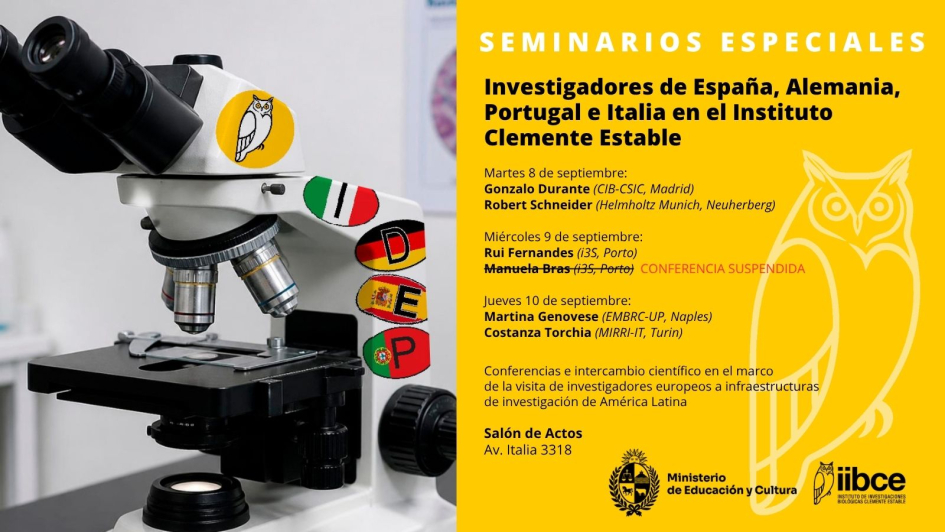
Bioconversion and biosensing of pollutants / Regulators of gene expression
Dos conferencias a cargo de científicos de España y de Alemania
- 10:00
- Salón de Actos del Instituto de Investigaciones Biológicas Clemente Estable / Zoom
Gonzalo Durante
Center for Biological Research Margarita Salas (CIB-CSIC), Madrid. The research infrastructure is hosted at the Center for Biological Research Margarita Salas (CIB-CSIC, Spain), a public research institute funded by the Spanish National Research Council (CSIC). Its thematic areas include 3 departments: Molecular and Cellular Biosciences, Biomedicine, and Biotechnology. The infrastructure integrates molecular biology, sequencing, analytical chemistry, microbiology facilities, microscopy, NMR, genomic and proteomics, and participates in national and international research networks and collaborations across Europe, Latin America, and other countries.
I have extensive experience in international research cooperation, particularly between Europe and Latin America. I coordinated the LincGlobal network involving seven research groups from six Latin American countries and currently coordinate the communication activities of the CYTED RIOBIC network. I have promoted several cooperation agreements between CSIC and institutions in Chile, Costa Rica, Argentina and Uruguay, including IIBCE, and maintain active collaborations with research groups across Europe and Latin America.

Robert Schneider
Helmholtz Munich (HM) belongs to the Helmholtz Association, the largest German research Institution. It is funded by the German federal government (90%), the state of Bavaria (10%) and substantial third-party funding. It currently has 2400 employees. Scientific excellence is top priority. The Institute of Functional Epigenetics (which I direct) is part of HM. Its mission is to uncover how epigenetic information is stored and how the environment controls our epigenome in order to identify novel therapeutic targets. Epigenetics@Helmholtz brings together >30 groups on epigenetics related topics.
Since the start of my scientific career I have been strongly committed to fostering international collaborations. I myself have worked in France, UK, USA and Germany and have currently active collaborations with partners in Europe, China, Saudi Arabia, USA, Canada. I have organised many international meetings and conferences. For me training of future generations of scientist has always been a central priority. To support this vision I founded and currently serve as spokesperson for an International PhD program joint between Helmholtz Munich and University of Edinburgh (MRC and Welcome Trust)